Whitefly Spraying vs. Systemic Drench: Which Works Better in South Florida?
The short version
| Foliar spray | Systemic drench or trunk application | |
|---|---|---|
| Speed | Hours to days | About 1 to 3 weeks to build up |
| Coverage | Only what the spray touches | The whole plant, including tall and dense areas |
| Duration | Days to a couple of weeks | Months |
| Weather sensitivity | Rain and wind reduce results | Less affected once absorbed |
| Impact on beneficial insects | Higher, especially with broad products | Lower contact exposure |
| Best for | Heavy active outbreaks and small plants | Hedges, palms, trees and prevention |
How foliar whitefly sprays work
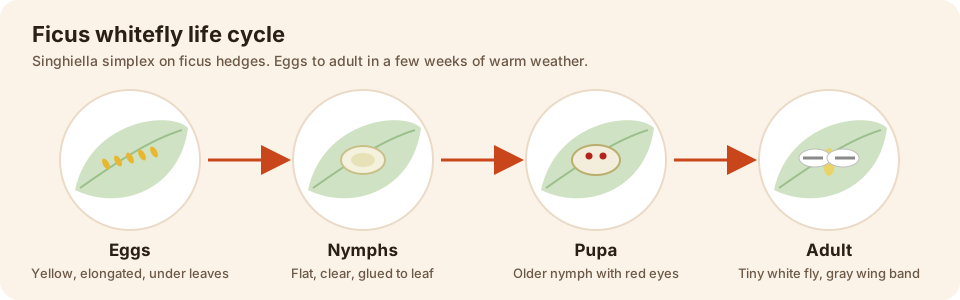
A foliar spray is applied directly to the leaves. Contact products like insecticidal soap and horticultural oil smother soft-bodied whitefly stages. Other insecticides kill adults and nymphs they contact. The problem is coverage. Whiteflies live mostly on the undersides of leaves and deep inside dense growth. In a 10-foot ficus hedge or a 30-foot palm, there is always a population the spray never reaches, and those insects restart the outbreak within weeks.
When spraying makes sense
- A heavy outbreak with adults swarming that needs immediate relief.
- Small plants and shrubs where you can reach every leaf.
- Plants where a systemic is not appropriate, based on the label.
How systemic whitefly treatments work
A systemic insecticide is applied to the soil around the roots, or to the trunk, and the plant absorbs it and moves it through its tissues. Whiteflies feeding on sap anywhere on the plant take in the product. Because it is inside the plant, rain does not wash it off the leaves, and protection lasts for months.
Why systemics take time
The plant has to absorb and move the product, so results build over one to three weeks depending on the product, the plant's size and how actively it is growing. Watering in properly and treating when the plant is actively growing improves uptake.
Common systemic options
Professionals commonly use neonicotinoid active ingredients such as imidacloprid and dinotefuran for whitefly on ornamentals. Some act faster than others and some last longer. The right choice depends on the plant, the severity, the soil and nearby water, and the label directions.
Why we often combine both
For a ficus hedge that is actively dropping leaves, waiting three weeks for a systemic alone means more leaf loss. A targeted spray stops the immediate damage, and the systemic takes over for long-term control. For prevention on a healthy property, a scheduled systemic program on its own is usually enough.
Safety: pollinators, pets and water
- Follow the label. It sets rates, timing, re-entry intervals and restrictions near water.
- Protect pollinators. Avoid treating plants in bloom that bees visit, and never spray open flowers.
- Keep products out of waterways. Respect buffer zones near canals, lakes and storm drains.
- Kids and pets. Keep them off treated areas until the label says it is safe. We tell you exactly when.
What about DIY products?
Homeowner whitefly products are available, but they are usually dosed for smaller plants. Under-dosing a large hedge or palm gives poor control and encourages resistance, while over-applying wastes money and risks harm. Large hedges and trees are where professional measurement and dosing make the biggest difference.
Frequently asked questions
Is it better to spray or drench for whitefly?
For hedges, palms and trees, a systemic drench gives longer and more complete control. Sprays work faster but wear off quickly and miss insects they do not touch. Many outbreaks are best handled with both.
How long does a whitefly systemic drench take to work?
Typically about one to three weeks, depending on the product, plant size and growing conditions.
How long does a whitefly drench last?
Systemic treatments generally protect plants for several months, depending on the product and label.
Can rain wash away whitefly treatment?
Rain can wash off foliar sprays, but a systemic product absorbed by the plant is not washed off the leaves.
Is whitefly treatment safe for pets?
When applied according to the label and pets are kept off treated areas for the required time, treatments are applied safely. We give you specific re-entry guidance for each visit.