Ficus Whitefly in Broward County: How to Identify, Treat and Prevent It
What is ficus whitefly?
Ficus whitefly, also called fig whitefly (Singhiella simplex), is an invasive insect native to Asia. It was first detected in Miami-Dade County in 2007 and quickly spread through Broward and Palm Beach counties, where ficus hedges are one of the most common privacy screens. Today it is one of the most frequent reasons homeowners call us about a hedge that is suddenly going bare.
Despite the name, whiteflies are not true flies. They are close relatives of aphids, scale and mealybugs, and they feed by piercing leaves and drinking plant sap. A heavy population drains the plant, and the ficus responds by dropping leaves.
Which plants does it attack?
Ficus whitefly feeds on ficus species. In South Florida landscapes it hits weeping fig (Ficus benjamina) hedges hardest, along with Cuban laurel and other ficus trees. Not every ficus species is equally susceptible, but on susceptible plants, dense infestations stunt growth and strip foliage.
How do I know if my hedge has ficus whitefly?
- Sudden leaf drop. Leaves turn yellow and fall, sometimes while still mostly green. You may be raking or blowing leaves daily.
- Thin, see-through patches. The hedge loses density from the inside out and you start seeing your neighbor's yard.
- Tiny white insects. Shake a branch. Small white adults with a faint gray band across the wings flutter out.
- Eggs and nymphs on the leaves. Use your phone camera to zoom in on leaves. Unlike many whiteflies, ficus whitefly immatures can be found on both the top and bottom of the leaf.
- Sticky honeydew and sooty mold. A sticky film and black powdery coating on leaves, cars, pavers and walkways below the hedge.
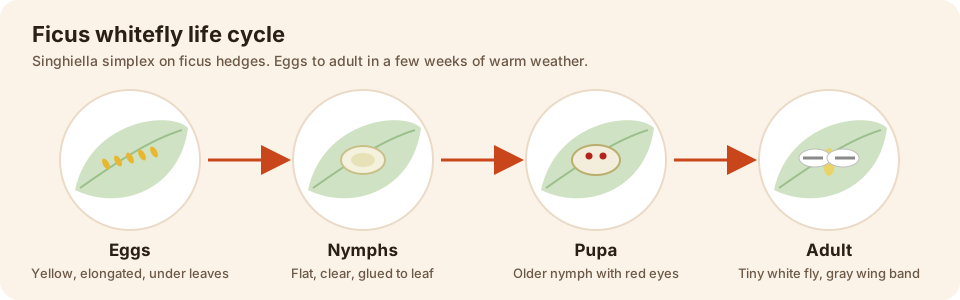
Ficus whitefly life cycle
Knowing the life stages helps you confirm the pest and time treatments.
- Eggs. Small, elongated and yellow to light brown, laid on the leaves.
- Nymphs. After hatching, the young settle down, flatten against the leaf and feed. Early nymphs are nearly transparent and easy to miss.
- Pupa (late nymph). The older nymph shows conspicuous red eyes through its body.
- Adult. The adult emerges through a T-shaped slit, flies to new leaves and starts laying eggs.
In South Florida's warm weather the full cycle takes only a few weeks, and generations overlap year round. That is why a hedge can decline so quickly and why one spray is rarely enough.
Ficus whitefly treatment options compared
| Method | How it works | Speed | How long it lasts | Best use |
|---|---|---|---|---|
| Systemic soil drench or trunk application | Absorbed by roots or trunk and moved through the plant, reaching whiteflies wherever they feed | Builds over 1 to 3 weeks | Months | Primary treatment for hedges and trees |
| Foliar insecticide spray | Kills adults and exposed nymphs on contact | Fast | Short | Knocking down heavy outbreaks while a systemic takes effect |
| Horticultural oil or insecticidal soap | Smothers soft-bodied stages on contact | Fast | Short, needs repeat coverage | Light infestations and small plants, lower impact on beneficial insects |
| Biological control | Natural parasitic wasps and predators attack whitefly stages | Slow | Ongoing | Long-term suppression, supported by avoiding broad repeated spraying |
Systemic products commonly used by professionals for whitefly on ornamentals include active ingredients such as imidacloprid and dinotefuran. Product choice, rate and timing depend on the plant, its size, nearby water and the label. The label is the law, and following it protects pollinators, pets, people and waterways.
Our step-by-step treatment approach
- Confirm the cause. Leaf drop can also come from drought, overwatering, root damage, cold or recent pruning. We inspect leaves and stems before treating anything.
- Measure the hedge. Systemic rates are based on plant size, so we measure linear feet and height or trunk diameter for accurate dosing.
- Apply the systemic. Soil drench or trunk application, depending on access, soil moisture and the plant.
- Knock down heavy outbreaks. A targeted foliar spray when adults are swarming.
- Support recovery. Correct watering and balanced nutrition so the hedge pushes new growth.
- Monitor and re-treat on schedule. Neighboring hedges reinfest yours, so protection is maintained through a recurring program.
How long does a ficus hedge take to recover?
New leaves usually start to appear within several weeks after the whitefly is under control, with the hedge filling back in over a few months during the growing season. Do the scratch test: lightly scratch a twig with your fingernail. Green tissue underneath means the branch is alive and will leaf out again.
What not to do
- Do not cut the hedge to the ground. Severe pruning removes the stored energy the plant needs to regrow.
- Do not spray over and over with broad insecticides. This kills the parasitic wasps that help control whitefly and can make outbreaks worse.
- Do not over-fertilize with high-nitrogen products. Lush, soft growth can attract more sap feeders.
- Do not wait. The longer a hedge goes bare, the longer recovery takes.
Prevention for Broward and Palm Beach properties
- Inspect hedges monthly, especially in warm months.
- Keep a preventive systemic program on schedule if whitefly is common in your neighborhood.
- Water deeply and consistently. Drought-stressed ficus suffers more.
- Consider replacing badly declined sections with plants that whitefly does not favor if you are tired of the cycle.
Frequently asked questions
What does ficus whitefly look like?
Adults are tiny white flying insects with a faint gray band across the wings. Eggs are small and yellowish, and nymphs are flat and nearly transparent, with older nymphs showing red eyes.
Why is my ficus hedge losing all its leaves?
The most common cause in South Florida is ficus whitefly feeding on the sap. Drought, overwatering, root damage and cold can also cause leaf drop, so an inspection confirms the cause.
What kills ficus whitefly?
A systemic insecticide applied to the soil or trunk provides the most reliable, longest-lasting control. Foliar sprays knock down heavy outbreaks quickly. All products must be applied according to the label.
Will my ficus hedge grow back after whitefly?
Usually yes. If the twigs are green under the bark, the hedge is alive and typically refills over a few months after the whitefly is controlled.
How much does ficus whitefly treatment cost?
Cost depends on hedge length, height and access. We provide a free on-site assessment with written pricing. Ongoing protection is available through our residential plans starting at $85 a month.