Rugose Spiraling Whitefly in South Florida: Signs, Host Plants and Treatment
What is rugose spiraling whitefly?
Rugose spiraling whitefly (RSW), once called the gumbo limbo spiraling whitefly, is native to Central America. It was first described in 2004 from samples collected in Belize, and the first established population in the continental United States was reported in Florida in 2009. Since then it has spread across South Florida and beyond.
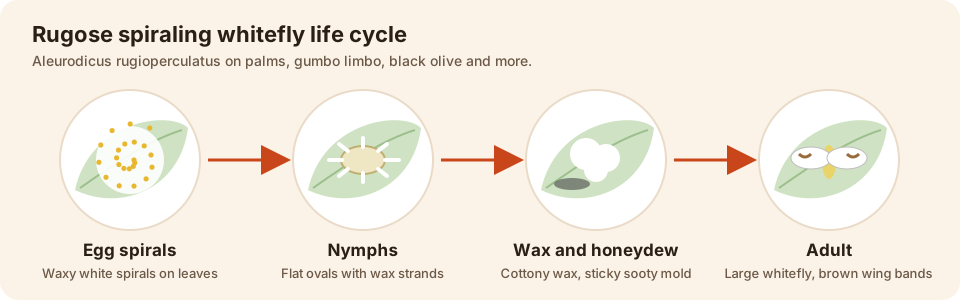
RSW is noticeably larger than most whiteflies. Its signature is the egg spiral: circular swirls of white wax with eggs embedded in them, usually on the underside of leaves.
Which plants does rugose spiraling whitefly attack?
Researchers have recorded RSW on well over 100 plant species. Early Florida records showed palms were the most commonly affected hosts, followed by gumbo limbo, Calophyllum, avocado, black olive and mango. In South Florida landscapes we most often find it on:
- Coconut palms and other palms
- Gumbo limbo
- Black olive
- Calophyllum (Brazilian beautyleaf)
- White bird of paradise
- Mango and avocado
How to identify rugose spiraling whitefly
- Egg spirals. White waxy spirals on leaf undersides. Females sometimes lay them on cars, windows and walls too.
- Waxy nymphs. Flat oval nymphs covered in white, cottony wax, often in dense colonies.
- Large adults. Adults have a pair of irregular light brown bands across the wings. Males have pincer-like structures at the tip of the abdomen.
- Honeydew and sooty mold. Sticky residue on everything below the tree, followed by black mold.
- Ants and wasps. Honeydew attracts ants that protect the whiteflies from their natural enemies.
RSW life cycle
- Egg spiral. Eggs laid in waxy spirals on the leaf.
- Nymphs. Hatchlings settle and feed, producing wax as they grow. Fourth-stage nymphs have raised sides.
- Adult. Adults emerge through a T-shaped opening and move to new leaves.
University of Florida research found the life cycle takes roughly 30 days at about 81 degrees Fahrenheit, so several generations develop every year in South Florida.
Is rugose spiraling whitefly killing my tree?
On its own, usually not. On healthy, established trees, RSW is mostly a nuisance: sticky residue, black mold on cars and pool decks, and reduced vigor. The real risk is to young plants, palms already stressed by nutrient deficiencies and trees with repeated heavy infestations. Sooty mold also blocks sunlight from reaching the leaves, which slows growth.
How to control rugose spiraling whitefly
1. Protect the natural enemies
Parasitic wasps, lady beetles, lacewings and other predators feed on RSW. Repeated broad-spectrum spraying kills them and often leads to bigger outbreaks. Controlling ants that protect the whiteflies also helps natural enemies do their job.
2. Treat high-value and heavily infested plants with a systemic
A soil-applied or trunk-applied systemic insecticide reaches whiteflies feeding on the leaves while limiting contact with beneficial insects. This is the preferred option for palms and trees that are too large to spray thoroughly. As with all pesticides, product, rate and timing follow the label.
3. Wash off wax and honeydew
On reachable plants, a strong stream of water removes wax, nymphs and honeydew. Insecticidal soap or horticultural oil can help on small plants with good coverage.
4. Keep plants healthy
Correct palm nutrition and watering help trees tolerate feeding and outgrow damage. See our palm fertilizer schedule.
5. Clean up sooty mold the right way
Stop the honeydew first, then clean surfaces. Our guide to removing sooty mold covers cars, pavers and pool decks.
How RSW compares to ficus whitefly
| Rugose spiraling whitefly | Ficus whitefly | |
|---|---|---|
| Main hosts | Palms, gumbo limbo, black olive, many others | Ficus hedges and trees |
| Key sign | White waxy egg spirals, cottony wax | Sudden heavy leaf drop |
| Adult size | Large, with brown wing bands | Small, with a faint gray wing band |
| Typical damage | Honeydew, sooty mold, reduced vigor | Defoliation and thinning |
Frequently asked questions
What are the white spirals on my palm leaves?
White waxy spirals on the underside of palm, gumbo limbo or black olive leaves are egg spirals laid by the rugose spiraling whitefly.
Does rugose spiraling whitefly kill palms?
It rarely kills healthy, established palms on its own, but it weakens stressed palms and young plants and causes heavy honeydew and sooty mold.
How do you get rid of rugose spiraling whitefly?
Protect natural enemies, treat high-value or heavily infested plants with a label-directed systemic insecticide, wash off wax and honeydew, and keep plants well fed and watered.
Why is there black mold on my car under my tree?
Black film on cars and pavers is sooty mold growing on honeydew dropped by insects like rugose spiraling whitefly or scale feeding in the tree above.
When did rugose spiraling whitefly arrive in Florida?
The first established population in the continental United States was reported in Florida in 2009.