Palms
Lethal Bronzing in South Florida Palms: What to Know
Lethal bronzing is a fatal palm disease caused by a phytoplasma, a bacteria-like organism that lives in the palm's sap. It has killed thousands of palms across Florida, including the state tree, the sabal or cabbage palm.
Palms at risk
Sabal palms, queen palms, Canary Island date palms, edible and other date palms, and several other species are known hosts.
How it spreads
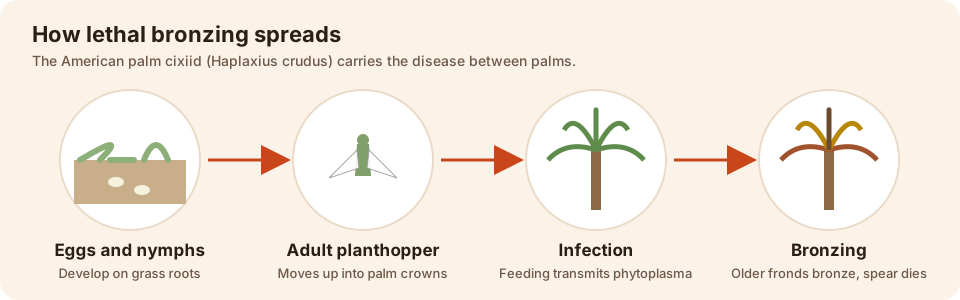
A small planthopper called the American palm cixiid (Haplaxius crudus) carries the disease. Its young develop on the roots of lawn grasses, then the adults fly up into palm crowns to feed and spread the infection from palm to palm.
Symptoms
- Fruit drops early and flower stalks die.
- Older, lower fronds turn bronze or reddish brown, then the discoloration moves up the crown.
- The spear leaf, the newest unopened frond, dies. At that point the palm cannot recover.
What you can do
- Get it confirmed. Nutrient problems can look similar early on. Lab testing of a trunk sample confirms the disease.
- Remove infected palms promptly. There is no cure, and an infected palm left standing can serve as a source for others.
- Protect nearby high-value palms. Preventive antibiotic trunk injections, applied on a regular schedule according to the label, can help protect palms that are not yet infected. They do not cure palms that already show symptoms.
- Replant smart. Choose replacement palms that are not known hosts.
Not sure what is wrong with your plants?Book a free plant health assessment in Broward or Palm Beach. Call or text 954-799-9715.Get my free assessment